The Amazing Jyväskylä!

The Amazing Jyväskylä!
Me at the harbor of Jyväskylä
Showing posts with label Internship in Kathmandu. Show all posts

23 November, 2014

Field visit to Okhaldhunga: Words have failed me! (Part 1)

Finally, I got to go on a field visit!

The day started at 2.45 am. I had been told that at 3.45 am, my colleague would come to pick me up in a taxi and we would go to the jeep station together. Anyway, he only arrived at sometime past 4 am and we left for the station leaving the vigorously barking dogs behind. A short ride on the taxi took us to a dusty place just next to the high way. There was light coming from a tiny office which was already packed with people trying to secure the tickets. My colleague went ahead to that office without saying anything, but I understood I should just wait for him outside. As I was waiting, of course, I was also observing. That's my curse. It was still dark at the time and a bit chilly too. I saw all kinds of bags lying on the ground. There were more men than women; the ticket office was full with men and the women were waiting outside to guard their belongings. I thought they might have been transporting products back home for their business or something. That was utterly lots of stuff, I told myself. Everyone was in warm clothes but I knew soon it would become a pain for them when the sun came up. I had a T-shirt and a hoody on, which was quite okay for me with this kind of weather in Kathmandu. I somehow had the feeling that people here are really afraid of the cold. When it was only 20 degree, I already saw bulky, buffy jackets on the street. In the office, everyone was wearing sweaters and windbreakers. I was reminded of Hanoi. However, having spent 6 months of winter in Finland, this was absolutely summer for me. I was still rocking short-sleeve T-shirt.

Anyway, we boarded a 9-seat jeep to one of PEEDA's project sites in a district called Okhaldhunga, an extremely mountainous area 125 km South East to Kathmandu. Even though a jeep was only allowed to carry 9 people including the driver, of course 10 of us were packed inside. The explanation was that it would help with the bumpy and hilly roads, which turned out to be true but also resulted in my unprecedentedly terrible carsickness. And the blasting music played all the time inside the jeep did not help at all. The ride was in total 9 hours and I vomited my gut out every couple hours or so. Therefore, I decided not to eat or drink anything on the way until we reached the destination. My colleague was worried, I knew that. But he was a guy, and there're social protocol of interaction between men and women who are not related here in Nepal. And even I know development workers should be progressive, there're certain restraints that have been engraved into their mind. Or so I had presumed. So, bottom line, I understood I should take care of myself. But I could tell he felt bad for me. He kept asking me: "Okay, Phuong?" and if I had any strength left after the vomiting section, I'd say "yes, I'm okay"; otherwise, I would just give him a confirming nod. There was another guy as well who worked for a partner NGO with PEEDA called SAHAS Nepal. He was designated as project coordinator in Okhaldhunga and he went with us this time. Since I decided not to eat until we reached the destination, every time they had something to eat and I said no, my colleague from PEEDA would say: "Sorry, we're eating." That was sweet of him, I thought. Other passengers in the jeep also gave me sympathetic looks any time they were face-to-face with me, which was kind of heart-warming though. Even though there was nothing they could do for me, it did show that they were at least concerned. (and probably asked themselves what the hell this foreigner was doing here!)

After the seemingly endless jeep ride, we finally arrived at our destination, Maneybhanjyang VDC, at around 3 pm and I was completely drained. I needed to rest my head where it would not move constantly and vigorously. After having some warm milk tea in an eatery, my colleague showed me where I would stay for the night. It was a room on the ground floor of a 2-story house where PEEDA staff always stayed when they were there. I would be sharing the room with 2 other sisters who were locals. When I told them I was from Vietnam, they looked puzzled and they didn't speak much English, so I took out my notebook and tried my best with recalling and drawing the map of South Asia and showed them where Vietnam was. At the time, there were three of them: Pramila, Rinuka and Sarmila. But later on, only 2 of them stayed the night with me in the room. 

Maneybhanjyang VDC
After that short greeting, I lied down to take a nap. As soon as I started feeling cold when it was getting to late afternoon, I was woken up by Pramila because she was covering me with a thick blanket. Still half-awake, I managed to whisper a weak "thank you" and slipped back to sleep, somehow for a split second, it crossed my mind that when I was much younger, I used to cover my dad with the blanket as well when he took his lunch nap and left the fan running a bit too strong. I think I was sleeping for about 1.5 hours until I woke up again with Pramila trying to confirm if I had been carsick and vomiting on the way there. I confirmed the information and realized that now my head was clear and the dizziness had somewhat faded. Pramila asked if I wanted tea, I gladly said yes. My body was really longing for some hot fluid. I got up. 

While waiting for Pramila to boil water for tea, I went out to wash up and paid a visit to the toilet. Before coming here, the girls at the office were warning me about the bad condition of the toilet here. But as I saw it, they might have been exaggerating a bit. It was not all that bad. I've seen worse in the country side of Vietnam when I was cycling across the country for a month. The only thing is that I had to go down a narrow path and climb a few steps on the stairs to reach the toilet, which was kind of inconvenient at night but if I didn't drink much water in the evening, I should be fine. This was the part where the girls at the office were complaining about. However, come to think about it, toilets should be located far from living area for sanitary reason, which makes the location of the toilet here more or less reasonable.

Women are super strong here!

At 7, we went out back to the small family eatery in the village to have dinner. We had some very typical Nepali food: Dal-Bhat which includes rice, dal, achar (which was too hot for me!), vegetable curry and local chicken. It took me quite a long time to eat because I was also watching the TV at the same time with the children of the family. I had not watched TV for quite some time now so every time I saw a TV, I was like enchanted or something. It didn't matter that I did not understand at all what the programs were about, my eyes did not leave the screen. I wish I could have stayed a bit longer but they were closing the door so I thought it was time to go. This family had quite many children and there was only one boy. All the girls were beautiful and seemed pretty smart. The boy was, as my colleague said, "a good guy". However, it looked like he received special treatment from the mother and he was very well aware of that. Well, this was what I did not enjoy seeing. He would boss his sisters and even his mother around whenever he could. But the mother and sisters would not say anything against him and do what he wanted them to.

Then, we came back to the guesthouse, agreed on the time to meet the next day and said good night. I went inside the room to find both the sisters already settle in bed. I changed my clothes and also crawled to bed.

It was no doubt a long day but it opened my eyes. During the jeep ride, I felt like I was going to the end of the world. In a sense, it kinda was, I guess. The place was isolated by a big river. We had to cross an enormous bridge on foot and change the vehicles once. That reality caused my respect and admiration I had for development workers here to shoot up to the sky since they go on field visit every 1.5 months or so for monitoring.

A local shop in Maneybhanjyang VDC
The beautiful Maneybhanjyang VDC

During the time I worked for a livelihood program in Quang Tri, Vietnam, I had my share of suffering hilly and bumpy roads. However, what I had witnessed up to this point of the trip was at a whole new level. The majority of the roads to Okhaldhunga was dirt road filled with countless pot holes and rocks. Once the jeep had passed one dense and rough series of turns and we ended up in yet another mountain even before I knew it; and I could see the part of the roads that we had just passed, I could never believe that snake-like image engraved on the mountain were actual roads where buses and jeeps could pass. If you have never been to a developing country, just imagine the worst condition of roads that you have witnessed in your life, the pot holes you occasionally come across and multiply it to ... say ... 10 thousand times and also remember that you ride on that kind of road for 9 hours when always covered in dust because there is absolutely no air-condition inside the jeep so the window opens most of the time.
Jump to 2:18 to see the road conditions, I specifically remember this part of the ride since it was terrifying!


And I was told this was already among the good roads. Now, that did leave me speechless.  

No money is enough to pay for what development workers do here at daily basis; especially those based in the community, living far from their families and traveling frequently with very bad roads conditions. It takes much more of just wanting to earn a living to remain in this job in Nepal, I would think.


31 October, 2014

Tihar, when "sweet" bears both literal and figurative meanings ;)

The second most important festival of Nepal has come and gone but the marks of Rangoli in front of every house's door will stay put for a while.

While during Dashain, Hindus worshiped Goddess Durga - the source of power for the Hindu trinity Shiva, Brahman and Vishnu, during Tihar, they worship Goddess Laxmi - the wife of Vishnu, the Goddess of spiritual and material prosperity, wealth and fortune. She is also the embodiment of beauty since she is believed to be an extremely beautiful woman herself.


A mandala of Goddess Laxmi in the making
Final work
This is a five-day festival with interesting customs conducted every day. The first day is for worshiping crow (Kag), the messenger of Death. On the second day, many dogs (kukur) here are seen with tika and flower collar (garland?) because they are the object of worshiping. This is to celebrate the tight relationship between men and dogs. Cows are worshiped on the third day, also with puja (ritual ceremony) to put tika and garland on them. This is also the day when people do puja to worship Goddess Laxmi because cows are believed to be one of the incarnations of Goddess Laxmi. In the afternoon of the third day, a trail of red mud is drawn by the woman in the family from the front door to the place in the house where Goddess Laxmi is worshiped. Afterward, when the mud is dry, they draw footprints on the trail to symbolize that the Goddess has already come into the house. At the beginning of the mud trail, many families arrange flowers and candles to make it into very beautiful Rangoli. The forth day is actually celebrated differently among different communities in Nepal. For the Newari, one of the original settlers of Kathmandu, they call it "my day", meaning one worships oneself on this day. For others, this is the day for worshiping ox. The last day is the most important day and to me personally, my favorite day because of its lovely meaning. It is called Bhai Tika. Bhai means brother. So this day is for honoring the bonding relationship between brothers and sisters.

Mud trail and Goddess Laxmi's foot prints (well, it's supposed to have a trail but my landlords did not draw it because they would have had to draw the trail all the way up to the top floor of their 3-story house
An example of a very pretty Rangoli

There are many different versions of legends about Tihar festival and particularly this last day. However, there's one legend that's more popular than most. Legend says that Lord Vishnu once gave Yama Raj (the God of Death) five days off in ruling his world. So, he went to visit his sister because it had been such a long time he had never seen her. When Goddess Yamuna, the sister of Yama Raj, saw her brother come to visit, she was so happy and did everything she could to keep him happy. At the end of his five days, Yama Raj was so pleased with the his sister's hospitality, he presented a unique gift to her; and granted that any brother who came to visit their sister on this day would have a wealthy and happy life.

The version that I was told by my co-workers at the office is that this festival started when a smart sister managed to save the life of her brother from Yama Raj, the God of Death. When it was time for Yama Raj to come and take away the soul of the brother, the sister invited him to stay for the honor of "brother worship" as well. The sister did the rituals so well that Yama Raj was very pleased and asked if she had any wish from him. So, she wished that he would not take the soul of her brother until seven-color tika she had smeared on his forehead faded, the oil around him was dry and the flower garland on his neck wilted. However, the oil never seemed to dry and left permanent trail around the brother. And the garland was made of a kind of purple flowers that would never wilt. Then, the soul of the brother was saved forever from the hand of Death.

Therefore, on this day, during Bhai Tika puja, sisters draw a circle around their brothers with oil, put seven-color tika on their brothers' forehead and flower garlands on their necks. All of this is for protecting the brothers from the Death and blessing them a wealthy, healthy and happy life. They also prepare very delicious meals for the brothers. In return, the brothers prepare gifts for their sisters to show their appreciation like Yama Raj did.

Those who do not have sisters go to a special temple called Yamaleswar Mahadev in downtown Kathmandu, in the middle of Rani lake to receive tika and blessing. This temple is locked all year round and only open once a year on the last day of Tihar.


Yamaleswar Mahadev temple in Rani lake

Only opened once a year, the temple attracts lots and lots of people on the last day of Tihar

It is a sweet and lovely tradition of Hindus and a heart-warming day for those with brothers and sisters.


Giving and receiving tika at Yamaleswar Mahadev temple
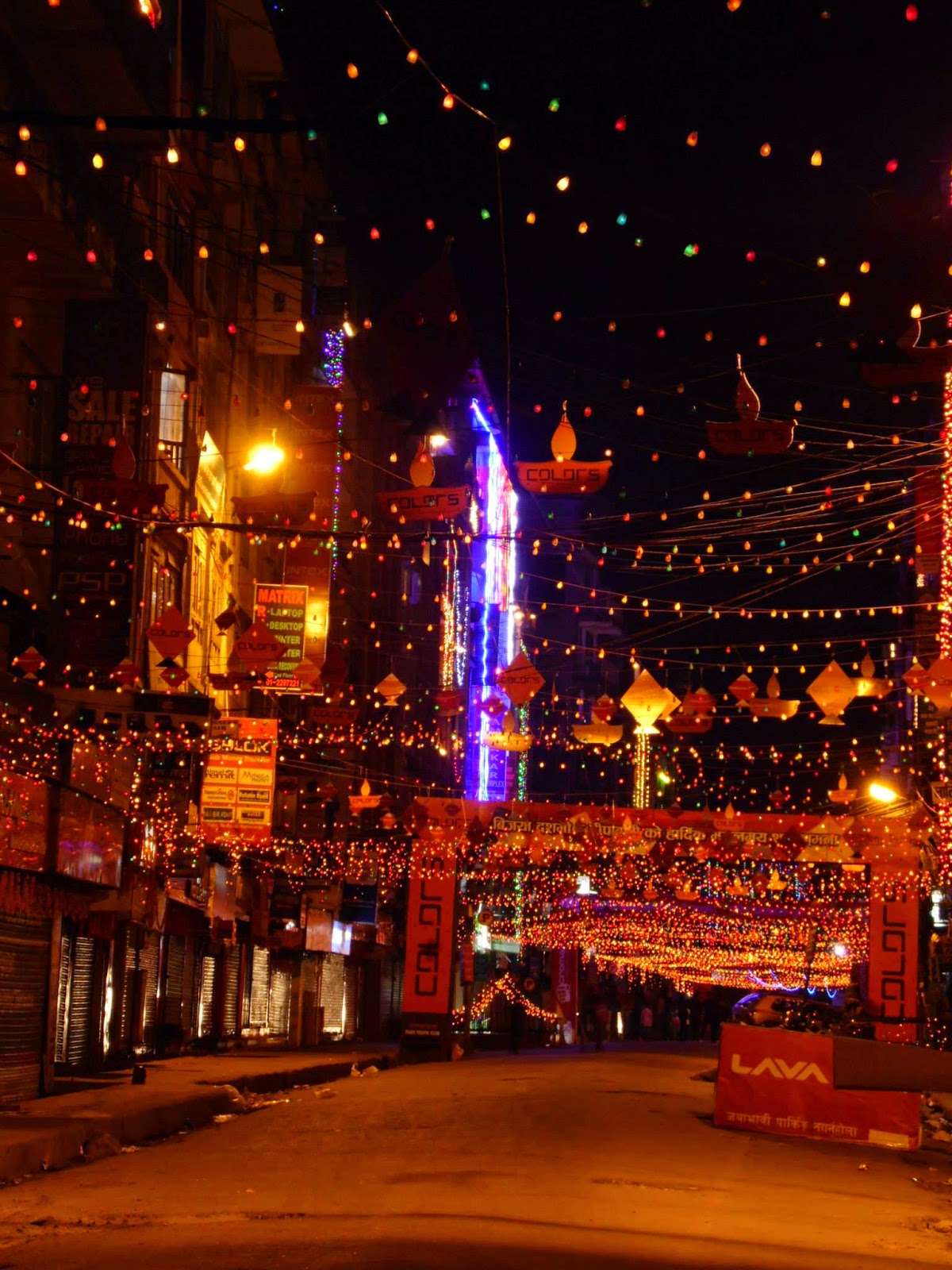
What I love most about this festival is that it is also called the festival of light. For three days straight, Kathmandu's citizens enjoyed full-time electricity with no load-shedding. The city was lit up in colorful lights. I kept saying (while vigorously taking photos): "This is such a luxury for Kathmandu ... well, but it's only once a year!"
Kathmandu city sparkling in lights (taken from Swayambhu Stupa)

In an alley, branching from one of the main roads in Kathmandu

A temple in Kathmandu Durbar Square, decorated with lights 

Kathmandu Durbar Square

Kathmandu Durbar Square

Another alley branching from a main road in downtown Kathmandu

Aside from roaming the city in the evening to take photos, I do not have any personal take on Tihar like I did during Dashain. I did come to my friend's house on the forth day and we made Selroti together, a sort of round donuts - traditional food during Tihar. It was lots of fun actually because no matter how much we tried, we could not get it in round and plumed shape like they did in the stores. Tihar is also the time for those with sweet tooth. Gosh, they eat so much sweets here for the past few days!

During Tihar, most shops were closed but sweets shops were always open! 

The streets and the markets during the week of the festival were filled with flowers garlands and colorful powder (for seven-color tika) being sold on pavements.
Color powder is mixed with water to make tika
Flowers garlands

I feel blessed and glad to be here during this festivals season. Kathmandu has been so lively, pretty and bustling with its busy citizens. Even modernity has had very visible impacts on people's lives here, I still hope these wonderful traditions will still live on to enrich the spiritual lives of many more Nepali generations to come. It makes me giggle every time I touch upon the matter of modernity and tradition, Escobar always comes to my mind. It could be that I have had to read his book Encoutering Development ... for so many times due to assignments at school. Almost 20 years ago, he was already worried about the local culture and traditions being destroyed by modernity because development was strongly accompanied with modernity and economic growth regardless of anything else. Development, as a result, was being conducted carelessly at the time in regard of culture preservation. Now, 20 years later, his prediction has become more visible than ever in developing countries such as Nepal.

When I was at Yamaleswar Mahadev to seize the opportunity of entering the temple which only happens once a year, right next to the traditional rituals being conducted, people with all sorts of digital devices: camera, smart phones, notepads ... vigorously taking photos and taping videos. Well, I am glad people's lives have gotten better in term of meterials. However, in situations like this, living in the moments should be more important than looking at them through the cameras lens. As a tourist, I do take tons of photos, I'm tired of it sometimes but I know I'm going to regret it afterward if I don't have some photos to mark places I've been or things I've seen. Well ... I could also be quite unreasonable sometimes.

08 October, 2014

The observation of books

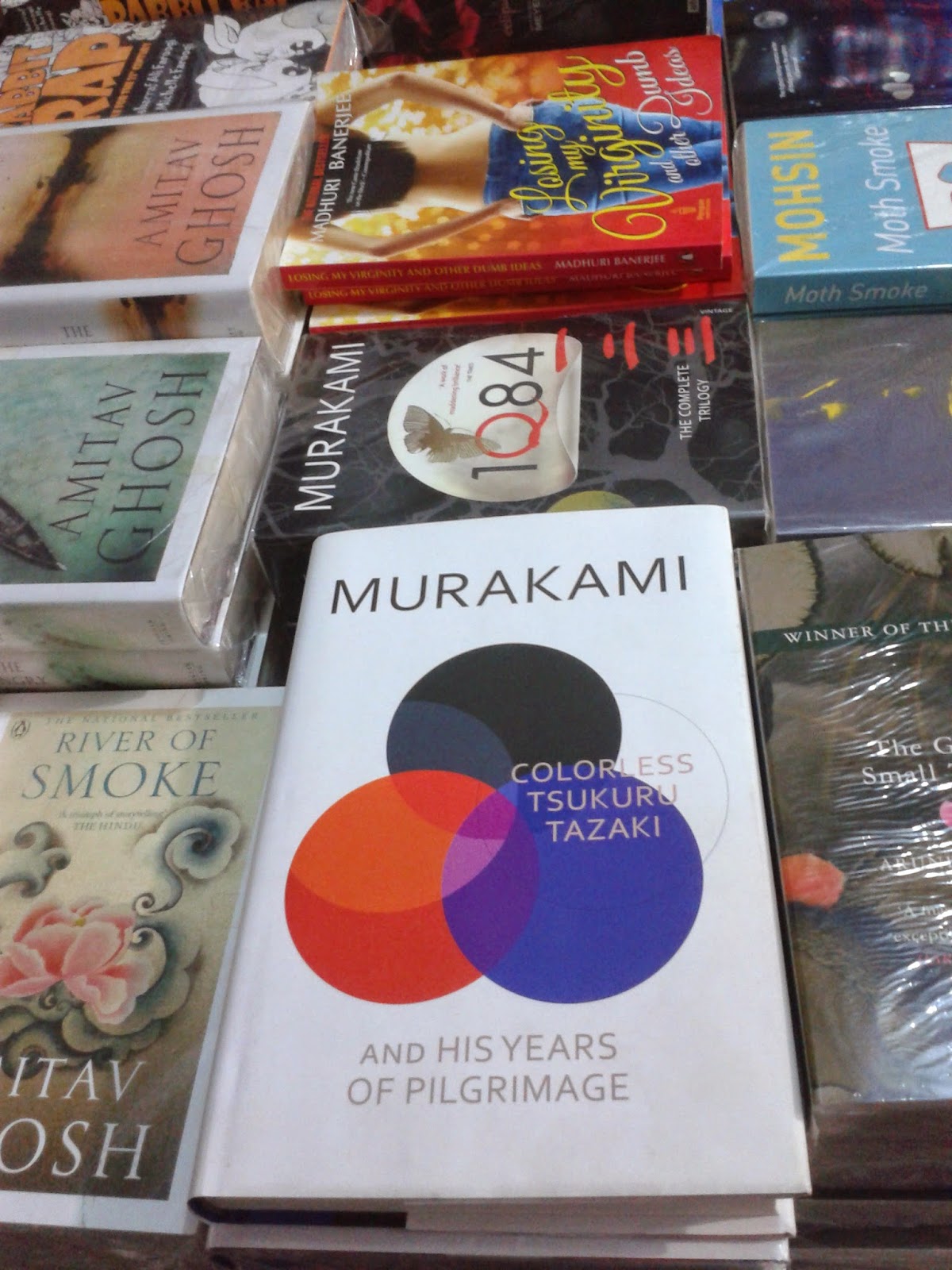
Once again, I found myself wandering around Thamel, a touristy area in Kathmandu. I had just borrowed a scooter from my friend and was too excited to ride it but did not know the way to any other place rather than Thamel. This time, I was hoping to score some Haruki Murakami’s books, English version, with an affordable price since I had visited some book shops in this area before and known that they carried lots of used books. It’s almost impossible for me to purchase the English version of his books in Vietnam or Finland. However, it seemed hopeless. Apparently, he is also very well-known here. His books are often displayed up front in stores and wrapped with plastic. A paper-cover book of his is about 8 dollars. Well, granted that it’s cheaper than on Amazon but still … it’s expensive for me. Even though it’s not hard to find pdf of his books online, it still feels better to physically have a book in hands and read it whenever I feel like doing it; because there’s no way I would understand Murakami’s books after reading them for the first time. Interesting note though, in Murakami's latest book (photo below), the main character goes all the way from Japan to Finland to find the truth to his past. There's some very familiar description of a summer cottage next to a lake somewhere in Hämeenlinna. 


Anyway, as I was intensively checking titles of hundreds of books in the “used books” sections in several book shops in Thamel, I was amused by the similarity of the books collection they have here. It would be the norm to find sections of books in anthropology, psychology, politics, economy, history and especially religion in most of the book stores in Thamel. I have not been to book stores in other areas yet so I cannot conclude for all. But it should be surprising to see books that belong to academic references other than traveling in this touristy area of the city. So far, I have spotted some books that I know of such as Making Globalization Work by Joseph Stiglitz (I’m actually doing a book report on this one!), The World Is Flat by Thomas L. Friedman, etc.

There are also lots of history books of which the highlight is Vietnam War. Yes, it seems like the world is very much interested in reading about what happened in Vietnam during the time we were fighting for our independence. I guess, the reason that it remains fascinating until this day is the existence of one tiny Asian country that was able to kick the most powerful nation in the ass by forces. Books about this war often flood the entire history section of several book shops that I’ve been to. Don’t get me wrong, I’m proud of the fact that the world knows of Vietnam with that strong image. However, I am very tired of hearing about it or being asked about it every single time people find out I am from Vietnam. I am fed up with documentaries about Vietnam starting with the statement: “… years after Vietnam war, the country is on a steady pace of development …” or something similar down that road. It is about time that Vietnam should be known about things other than the war such as its beautiful beaches, friendly people, to-die-for food, picturesque landscape or some fascinating professions like ceramics, pottery or even noodles-making, etc.

Regarding religion and culture, of course, there are hundreds of books about Hinduism and Buddhism; how they are practiced in Nepal, the number of God and Goddess (I was surprised that this book about Hindu God and Goddess was so thin, considering that there are approximately 300 million Gods and Goddesses in Hinduism!) There are several popular books about the Living Goddess, the unique religious tradition of Nepali. Oh, now I am reminded about this couple I met the other day in a book shop which was a pretty special one in Thamel. The guy asked the shop keeper to suggest him any book at all since it seemed like he was quite clueless on what kind of book he wanted. The shop keeper suggested him lots of best-seller books which were made popular by the movie version. Still, this guy couldn’t decide. I was reading a new Murakami’s book which was just released early this year. I then suggested that he should get one of Murakami’s books since they were terrific. However, when I was briefing one of the books to him and made a comment that Murakami’s works were quite dark and heavy, he said: “Oh, I am actually looking for something a bit bright and easy to read.” I said: “Well, you go ahead and look for some chick flicks then if you want something bright.” Upon existing the fiction section, I suddenly remembered a perfect book: From Goddess to Mortal. I mentioned it in one of the entries here. It’s a biography of a former Kumari, the Royal Living Goddess of Kathmandu. I turned back to suggest the book to the couple; it is absolutely a positive story, extremely interesting and it provides correct knowledge of the most fascinating tradition of Nepal from someone who has actually been through it. To my surprise, they were oblivious about this famous cultural feature of Nepal. I wondered how they did not even have a vague idea about Kumari when her photos are displayed every where around the city. And if I was not mistaken, the girl was holding a Nepal guide book as well and I am pretty sure that no Nepal guide book would miss out information on Kumari. Man, this is so unfair for the country. Guys, please, do some research before you travel to any country at all! You spend lots of money anyway, don’t waste it by coming back from the trip with only photos in your cameras.

*long sigh* haizz .....

Geography wise, books about Tibet are plenty in all the book stores. I’m not sure why though. Maybe it’s because they’re very close to each other and people often travel there after Nepal.

The number of fiction books though is the biggest among all. I think it is true in most books stores I’ve ever been to. The most popular series is obviously Dan Brown’s collection. Every single book store here carries Dan Brown’s, from used books to brand new ones. This is also true for Stephen King’s novels or Sidney Sheldon’s. And OMG, Twilights and Fifty Shades of Grey are every where! Well, I have to admit that I once finished more than 1000 pages of Fifty Shades of Grey within two weeks or so; when its e-book was still available on Internet. But it’s the kind of story that I would read for one time and then never come back to it again. So, I wouldn’t really want to spend money on the books. Twilights? Do not even mention it! What a waste of papers!

Sidney Sheldon collection

Stephen King collection

What I find surprising is some classic book series are so cheap here compared to the price of English books I would have to pay in Vietnam; especially Sherlock Holmes. I texted my younger sister immediately when I found out and she asked me to buy the collection of short stories for her. She cannot go through with the long stories. I checked and this collection cost 400 rupees (about 4 USD). I mean … wow! So, I’m thinking maybe I’ll buy the long-stories collection too, so that when her English is a bit more advanced, she’ll be able to read it. It’s good practice anyway. There’s no downside of purchasing a good book. Ah, lots of copies of Shakespeare’s plays are also often seen on display. 


Regarding reading culture, I do think many Nepali are big readers since they take education very seriously. Schools, colleges or universities can be seen in every corner of the city. Around my neighborhood, I can easily point out at least 10 education institutions ranging from kindergarten to  university. Even from the 80s, girls were already encouraged to go to schools and their families would be so proud if they did well in schools. I learned this from reading the book From Goddess to Mortal. The family of Rashmila – the former Kumari in the book, has four daughters and one son. All of them receive equal opportunities to attend schools and reach their academic potential. Because Goddess is believed to know everything, the chosen Kumari, the incarnation of Goddess Taleju, was not expected to attend classes. While most Kumaris (before the year of 2000, I think) retired from the office almost illiterate, Rashmila, with support from her family, found her way back to elementary school when she was already 12 years old. She had to work much harder than other students in order to skip 2 grades every year and catch up with students of her own age. Since the new democratic government was formed, there has been improvement on this matter. Kumaris now have their private teacher come to Kumari’s House (Kumari Ghar, in their language) to teach them for a few hours every day. So, when they retire from being Kumari, they can attend classes with students of their own age immediately without much struggle.

Pilgrim Book Store, Thamel 
Well, this entry surely makes me sound like a big reader but the fact is I am not. It is true that when I am really interested in something, I can spend hours reading a book about it. I enjoy going to book stores, reading books and ending up not buying anything, haha. But I find it interesting as I observe the book collections here. Supply should meet demand. Book stores carry books that are actually bought by readers. It would not make sense to do otherwise. So it also reflects on the reading taste of Nepali, even though this area is very touristy. 

A slogan on the importance of education on a street of Kathmandu

01 October, 2014

Dashain and a stronger sense of home ...

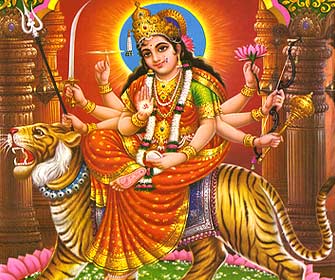
It’s the seventh day of Dashain festival in Nepal. It is the most important traditional holiday of Nepal that lasts for 15 days, an equivalence with Lunar New Year in Vietnam or Christmas in the West. This holiday celebrates the defeat of devils. The Goddess that is worshiped during this holiday is Durga, Mother of the universe. She is believed to be the force behind the power of creation, preservation and destruction which are represented by Brahman, Vishnu and Shiva respectively. The word "Durga" in Sanskrit means a fort, or a place which is difficult to overrun. Another meaning of "Durga" is "Durgatinashini," which literally translates into "the one who eliminates sufferings." Thus, Hindus believe that goddess Durga protects her devotees from the evils of the world and at the same time removes their miseries.

During this festival, what Nepali do the most is flying kites, which is meant to send a message to the God to stop sending rain down to the valley. Children enjoy playing with their giant bamboo swing. The sacrifice of goats’ blood to Durga and Kali Goddess. These Goddesses are known to fight the devils with their thirst of blood and furiousness. 

The children enjoy playing with their bamboo swing in my neighborhood

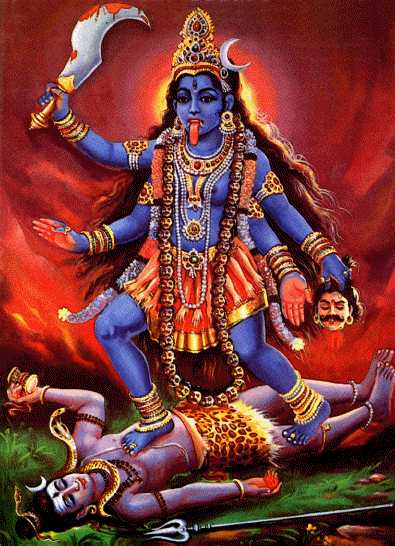
There’s an interesting story about Kali though. When the earth was invaded by devils, Kali – as an incarnation of Durga – came down to earth to fight the devils and free humans. She was strong and undefeatable. However, she was into the killing too deeply and got carried on too far to the point that she was killing humans as well. Shiva saw that and jumped under her feet when she was stomping on earth. When Kali looked down, the interference of Shiva awoke her from her uncontrollable anger and she stopped the killing. That’s why the most common statue of kali that we see depicts a Goddess holding human heads and one of her feet on Shiva.

Animation of Goddess Durga
Animation of Goddess Kali

A similar feature between Dashain and other traditional holidays in the world is that people go back to their hometown or visit their relatives. The women, of course, work their tails off in the kitchen to feed everyone during these gatherings.

I was fortunate enough to have been invited to a Nepali family to celebrate Dashain with them on the seventh day – one of the most important days of Dashain. It’s a traditional family: parents and 2 sons. I am the only friend of the younger son who invited me to their house; he works with me in the office. The rest of the guests were the oldest son’s friends from work and a group he often socializes with. When I was invited, the guy told me there would be all foreigners. So, I guessed he thought I would be more comfortable socializing with other foreigners living in Kathmandu. Well, I actually ended up spending most of my time hanging out with his cousins because I was not comfortable with the foreigners. I also enjoyed hanging around his mother when she was cooking. It made me a little bit homesick actually. But I felt like at home. In the end, she asked me to come back to have rice with them some other time; she said: "You are now our daughter, right?". I was really overwhelmed.

The father was delighted when he found out that I was from Vietnam because in the 70s, he studied with lots of Vietnamese in St. Peter Burg under Soviet Union time. He still even remembers some Vietnamese words after all these years. In fact, he was so delighted that he soon introduced me to the foreign guests as his daughter, which really took me by surprise and surely confused the guests tremendously. He told me that he had true respect for Ho Chi Minh. It made me so happy. It’s endearing that he and his wife really tried to pronounce my name correctly. Their son (the one that works with me) for some reason has no trouble pronouncing my name. I had not really noticed it until today. While seeing his parents, his older brother and other foreign guests struggling to pronounce my name, I suddenly remembered that from day one, he has been calling my name correctly with no effort at all. Strange! 

So, my friend, the only person I knew in the house, spent the whole afternoon flying kites with his bother’s friends on the roof top. His mother told me that this was the first time after 3 years that he got to enjoy Dashain since he had been studying in India until last July. I joined in with others on the roof top a few times. The rest of the afternoon, I was watching TV and talking with my friend’s cousins downstairs. They were very lovely kids whose English was excellent.

I am excited now because during this holiday, one of my friends will leave me her scooter since she won’t be in Kathmandu but will go back to her hometown with her husband and baby. I will get to go around the city on a scooter, which I haven’t been able to do for such a long time now. It should be fun! 

And my best friend is coming. I can't wait to see her. It's been over a year now!

23 September, 2014

Office

It’s been 20 days since I arrived in Kathmandu and started going to the office of PEEDA every weekday. It now already feels familiar; thanks to the welcoming and friendly colleagues.

The office of PEEDA is located in the middle of a street called Old Baneshwar and shares the same slot with a minor private TV Network of Nepal. It takes about 45 minutes to walk from my apartment to the office every morning but I do not mind because for me, it’s exercising. Pushing myself though crowds of people along bustling and busy streets of Kathmandu, even though it’s a rough walk, I feel so much alive. I know, it sounds quite cliché but it’s the truth. Seeing people hurry to schools, to work or to catch a bus reminds me that life is a busy train and it’s a blessing to have a seat on it.

On my first day at work, there were only 4 people working because everyone else was in the field. So far, I could only remember one or two days when the office was full of people and there were 11. I brought some chocolate and some salmiakki from Finland and to my surprise, my colleagues here liked salmiakki. Well, I’m glad they did!

We have a didi who is a lunch lady and also helps with errands around the office. She cooks for us every day so most of us have lunch together on the top floor of the office building. I enjoy lunch time a lot. Even though most of the time, I don’t understand what other people talk about, I take pleasure in hearing them talk and observing their gestures. I have to say Nepali are expressive people. When they talk, they have all kinds of expression on their faces to show how they feel about it, lots of time accompanied with hand gestures and head motion, which sometimes cracks me up. They are certainly the liveliest people I’ve met.

I always come in the office to see a bottle full of water and a clean glass already sitting on my table. Didi also brings each of us a cup of hot black tea every morning when everyone has arrived. When she puts the cup of tea on the table, she always turns the handle toward me so I’ll have easier access to it. It’s not like we are too lazy to reach out a few centimeters further to have a proper grasp of the cup’s handle but it’s the thought that counts. That just shows how considerate and thoughtful she is. I feel like being spoiled here.

I share a room with two other colleagues. One of them is the Community Development Officer (CDO) and the other is an intern like me but he’s Nepali. They’re both quiet people. While I can understand the intern perfectly with no problem whatsoever, I have a really hard time figuring out what the CDO talks about most of the time since his accent is sure very heavy. But that's fine, I'll get used to it soon. I have my own little table, which I’m perfectly happy with for my laptop is tiny as well.

You know, only after a week at the office did I realize that we never turn on the light in our room. We have sunlight for most of the day and even if it gets quite dark late in the afternoon, we all work on the computer so that doesn’t seem like a problem at all. And this way, we save electricity which is always lacking in the valley.

As I was reading about Nepal before coming here, I knew that Nepal’s society was a collectivism one. I had sort of figured since it’s an Asian country. However, some expats here complain on their blogs about how they do not have any privacy because of the collectivism character of the society. Well, I certainly see it differently. Even though I also come from a collectivism society, I do insist on having my privacy when I need it. However, I do also understand that when people ask questions, that’s because they care enough to do it. When they don’t bother asking questions anymore, you know that you have become invisible to them.

From the very beginning, the director and the head of administration kept telling me that we were a family here in PEEDA, so if I ever needed any help at all, I just asked and others would be happy to help me out. See, that’s a great thing about collectivism society. People feel the responsibility to help each other out. They are happy to be of any help. Unlike in Finland, you don’t have to hesitate when you feel like helping others. It’s not a crime! It’s encouraged.

Despite the struggle with allergy due to the air pollution here, I find the place heart-warming and it does give me a nice, though vague, sense of home.

22 September, 2014

Maybe the post-developmentalists were right after all ...

As much as I am trying to focus on completing another paper for the last compulsory course of the program, I cannot. While I concentrate on reading the books that are required for the course, other thoughts keep sneaking into my mind as the experiences that I have had so far here in Kathmandu are quite overwhelming and thoughts-invoking. So, no better way to get rid of these thoughts than writing them down (or typing them up to be exact).

Last weekend, I found myself yet again wandering around the touristy area of Thamel looking for a hair salon since I was desperate and determined to get a haircut while I am here. It is too expensive in Finland and the result I got was not worth the money I spent. Well, I was not really satisfied with the haircut I got here either but at least it was cheap. The hairdresser was sweet and welcoming even though I was 2 hours late for the appointment due to the rain. It was fast and cost me less than 2 euros comparing to the 15 euro haircut that took more than 2 hours to be done in Jyväskylä from an amateur vocational student.

Of course, small talks are inevitable while having a haircut; especially in a collectivism society like Nepal. Basic questions: where are you from? What are you doing here? How long have you been here? How long are you going to be here? She was much surprised when I told her that I was from Vietnam. Cannot blame her. I think very few Vietnamese travelers know of Nepal or consider traveling to Nepal since it is typical among our society that when we go abroad, we’d better go to rich countries like those in Europe or North America. This might go off track a bit but I find it laughable that when I talk to some younger Vietnamese students studying in Jyväskylä about going to Nepal, they find it strange and ask me if I am going there to do some charity work because they often go to France, Italy, Germany or even Greece for their internships or exchange programs. I don’t really bother to explain since it’s a waste of time explaining things for those with that kind of mindset. Alright, back to the hairdresser. So, when I told her that I was doing my internship at a non-governmental organization here in Kathmandu, she did not understand what I was talking about. However, I suddenly remembered the same reaction coming from a waiter in a coffee shop I went to the other day. And when I changed my answer to the abbreviation NGO instead of  full-on, spelled-out “non-governmental organization”, she immediately understood and so did the said waiter.

Very interesting …

Now, when I am doing some thinking and also reading a piece about aid work in Nepal from the book Development Brokers and Translators by David Mosse and David Lewis, I realize a very interesting fact. In this piece that I just mentioned, the author provided some statistics on the dramatic changes in the number of NGOs registered in Nepal: “From a mere 250 in 1989, the number of organizations registered with the Social Welfare Council in Kathmandu shot to 1,210 in 1993 and to 5,978 by 1997.” (p. 195) Then I went on doing some simple searching on Google to find out the most recent number. I found an official number on an online news outlet called Kathmandu Insider published in 2011. Apparently, as of 2011, there were approximately 50,000 NGOs and INGOs including ones registered with the Social Welfare Council (SWC) and those which were not registered. The official document listing registered NGOs from SWC has total 1,126 pages listing 30,284 INGOs and NGOs. http://www.swc.org.np/SWC_NGOs_Total.pdf

That is a tremendous number of NGOs and development workers in such a small country like Nepal. That number also gives us a hint of the amount of money pouring into developing Nepal every year. The article on Kathmandu Insider goes on analyzing the number: “Acting Deputy Director of the SWC, Uma Paudyal, informed that about 34,000 NGOs have been registered with the council to date. Moreover, there are many NGOs which have not yet registered at the SWC. She estimates that the total number of NGOs in the country must be around 50,000 already. Interestingly, given the population of the country, 34,000 NGOs means one NGO per 872 people! Or if the NGOs are centered on VDCs, eight NGOs can focus on one Village Development Committee (VDC). Similarly, 202 INGOs are working with the SWC, according to the latter. That being the case, it would not be wrong to expect far more from these non-profit organizations.” Unbelievable, right?

[I saw the sign of this project just across the road from Chinese Embassy]
First, it’s obvious that the term NGO has become a popular concept to Nepali, especially those living in Kathmandu. However, from the experiences I've had so far, I doubt that aside from development workers and their families, most Nepali do not understand what NGO even stands for; evidently the cases of the hairdresser and the waiter (and now, when I think about it, it's the same case with the guy who sells momo near where I live and claims to be my friend after selling me momo twice, haha) . I think they might have a vague idea what NGO workers might be doing but not really the whole picture. And of course, due to the huge number of NGOs, the expat community here in Kathmandu is incredibly large. There are two common questions posed for foreigners here: “Are you here to trek?” and “Are you working for an NGO?” Just like in Vietnam: “Are you here to travel?” and “Are you here to teach English?” And some Western NGO workers in Vietnam would be angry when asked if they teach English because they think that’s stereotype.

Secondly, I have to ask myself very obvious questions: With that incredible number of NGOs, why is Nepal still considered among the poorest countries in the world? What have they done for the past 25 years that this status hasn't changed at all?

Some typical reasons are laid out: corruption (which is true and quite serious in this case of Nepal); lack of resources (especially electricity); geographical difficulty-landlocked, weak governance; etc. … but … let’s face it, maybe Escobar, Ferguson and other post-developmentalists were right after all: development, the way in which it is being operated, is not working anymore …

15 September, 2014

Nepal 101

It’s Saturday and I got up at 5 am to accompany my landlady to the local market (or vegetable market to be exact) so that I’d know the way to get there if I want to buy vegetable for myself. It’s actually her morning routine that she would take a walk at 5 am, go home and have tea then go to teach at the university. However, it’s weekend and I had asked if she could show me the way to the market, I think she decided to do some groceries shopping as well. She said what she had bought might last for 2 or 3 weeks because the daughter didn't have lunch at home and they did not eat much though.

After leaving the house, at the corner between the alley and the big street, there’s a very small temple with a statue of an elephant God and she asked me too wait for her while she came inside the temple. There’s some sort of red powder surrounding the statue; I saw her touch the statue first and then put the red powder on the top of her forehead, this symbolizes the blessing from God, called Tika. So, very often, I see women with two red dots on their forehead: the one on top of the forehead is the blessing from God and the one between their eyes shows that they are married. Finally, to finish the ritual, she walked around the statue one time and came out of the temple. There’s also a bell hanging from above the statue and sometimes I see people ring the bell as well and touch their head and chest with their index finger but my landlady didn't do so. It’s an optional thing, I guess.

We reached the market after stopping by a dairy products shop and a spice shop. It’s a very common thing here that they eat yogurt after their meal. However, the taste of the yogurt here is quite different from what I am used to in Vietnam or in Finland. It’s not as smooth and also leaves a hint of citric after-taste. And regarding the spices, it’s amazing how many kinds of spices they have here. Of course, the common spices every one knows from Indian style of cooking such as cumin, turmeric, masala mix, cloves, star anise, cinnamon, etc. and lots of other spices that I have never come across  before. The vegetable market was huge. The basic vegetables that most of the stalls carried were cabbage, green pumpkin, daikon, morning glory, tomatoes etc. and only a few stalls had potatoes, garlic or limes. The limes here are exceptionally small!!!
The landlady and I walked all the way from one end to the other end of the market. She asked for the price, bargained and bought lots of them for a roughly two-week supply.


[Behind this fence is a small pond and behind the pond is the vegetable market]

[A close up of details on the fence]

[A close up of details on the fence]

Back to the house, the landlady invited me to have tea with her. She asked me if I wanted black tea or milk tea. I love the fact that milk tea is a norm here because I LOVE MILK TEA!!! Later, she said she had been surprised that I wanted milk tea because even though Nepali love their milk tea, normally foreigners preferred black tea. Well, I’m no normal foreigner! Hahaha =))
While having tea, we were talking about lots of things among which was her experiences of working with a Finnish project. My landlady is a chemistry professor in a renowned university in Kathmandu and she also runs a consultation firm. She took a leave from university for 2 or 3 years to work as a consultant for a project funded by Finnish government a long while ago, back in the 90s. She also paid a visit to Helsinki once during the project. We shared lots of common opinions about working with Finns in general.

After retiring from the tea session with the landlady, I came back to my room trying to figure out how to activate the internet package on my phone so that I would be able to use GPS and Google Map on my phone to explore the city. After a call to customer service with lots of “sorry, come gain?” or “sorry, I don’t understand what you mean”, I eventually managed to get the Internet working on my phone. The mobile Internet service here is actually very convenient if you know how to work it. They provide all kinds of Internet packages with amazingly cheap price. I only wanted to have the Internet available on my phone for 1 day so I activated the daily package of 20 MB worth of data for 10 rupees (1 euro = 126 rupees, so … you do the math). It lasted me for about 8 hours of constantly checking my location and occasional Facebook log-in.

I then walked my way to Thamel, a very touristy area in Kathmandu. This area is packed with souvenirs shops, cafes, restaurants, hostels, guesthouses and travel agencies. Some people would come up to me and asked if I wanted to use their services, I did have the tourist look with my camera and all. Even though the streets are always crowded during the day and motorbikes make their way through the traffic as fast as they can, people do not seem to be in a rush. I remember reading a blog written by an American expat about her life in Kathmandu and she said people here were always in hurry to go nowhere. However, from my observation from the past week, I can’t say I agree. It seems like they are in a rush if you look at the traffic. However, that’s just how it works when they don’t really have traffic lights and the flow mainly depends on the police. If they don’t go fast with their motorbikes or cars, no one knows how long they will be stuck in a busy intersection. Looking at the pedestrians; however, I see the opposite. They have a fairly relaxing and slow pace. I constantly find myself having to jump down to the street and then back again to the pavements in order to get pass other pedestrians who walk quite slowly. In Vietnam though, people are in fact always in a hurry to somewhere or nowhere. It’s just how we are, I guess.


[A type of cyclo lining up around Thamel to serve tourists]

[Similar displays in many shops in Thamel district]

Many of the stores are closed quite early at around 5 or 6 in the afternoon. I was quite surprised at first but then I realized that Nepali start their day very early. Many of them get up at 5 in the morning according to the rooster. The local markets are crowded around 5.30 or 6 and dismissed by 10 a.m. Aside from touristy area which is lighted all night, people go home around 5 p.m. and the streets are pretty empty at around 8. I was told that many families had dinner very late at 8 or 9.

Back to Thamel, there was nothing really special there aside from what you would expect from a usual hang-out location of foreigners. As I was buying some postcards to send home, I saw the name Durbar Square appear quite often. It must be a popular place to visit. So I decided to go there after having lunch in a local restaurant.

Durbar Square is a vast area covered with 49 Hindu temples, a palace and a history museum. I was surprised at first with the architecture of the palace which was absolutely European style. Apparently, one of the kings who came back from a visit to England really loved the architecture that he had seen over there and decided to build something similar. An English architect was actually hired to design this palace. It’s kinda odd seeing this palace standing next to the Hindu temples.


This is the place where one of the most important festivals in Kathmandu is hold annually: The Indra Jatra Festival. This is an extremely interesting festival which reminds me that I have been back to the land of legends and myths. And I do love to hear and to tell mysterious and mythical stories.

First, the name of the festival is Indra Jatra which is a Rain God. The statue of this God is often seen with tied hands since the myth says that he once came to the valley to steal a flower and was caught red-handed. Even when he said he was a God, no one agreed to let him go and tied his hands together. This story was to teach people that the act of stealing was not tolerated and the thief would be punished even if that was a God. However, since he was a God, the people in the valley made a deal with him that they would let him go in exchange for rain every harvesting season in the valley. Well, I think so far, he has kept his promise. ;)) More about it here http://www.weallnepali.com/nepali-festivals/indrajatra

A major event of this festival is the worshipping of Kumari – The Living Goddess. The Living Goddess is a young virgin girl who is chosen among many candidates from Newari community, Shakya clan from which Buddha was from. The myths behind the Kumari are all very interesting but long and quite complicated. Those who are interested can go to this link to read more. http://www.exoticindiaart.com/book/details/from-goddess-to-mortal-true-life-story-of-former-royal-kumari-IDI724/ This is a review of a biography written by a former Kumari about her life during the time of being worshipped as Kumari and the struggle to adjust back to the society after that. So very interesting that I spent the whole working day reading up about it. I’ll try to see if I can find this book here.


[Me trying to have a photo taken with the royal soldiers dressed in 18th century uniforms]

[Close-up of the current Royal Kumari of Kathmandu]

[Royal Kumari's chariot]

[The back of the chariot]

I was lucky enough to arrive in Kathmandu just in time for this important festival. I went to the first day of the festival which was September 8th and witnessed the pulling of Kumari’s chariot. The scene was incredible! Streets were packed with people playing musical instruments and pulling the chariots. My friend and I managed to get up to a restaurant’s balcony to have a clearer view of the Living Goddess. However, after passing the building that we were in, the chariot carrying Kumari was accidentally pulled off track and almost hit the building, a short while after that, it was stuck just down the road from where we were. When we were to leave the festival area, we had to push through ocean of people going against our direction. I was surprised finding myself totally okay with it even though I’d been living in a country where my personal space could go as far as 1 km to all dimensions and no one would stand closer than a stretch of the arm while talking to me. Such worlds apart!


[People are waiting to see the living Goddess Kumari]

[People are waiting to see the living Goddess Kumari]

I talked about this event with co-workers during lunch the next day. The director of the organization told me that if the top of the chariot falls down, which has happened several times, there will be some major changes or happenings in the valley during the year. He spoke of a year when there was a big massacre in the valley and the year when democracy took over and ended monarchy, the top of the chariot did fall off during the festival of those years. 

I also found a famous biography of a former Royal Kumari named Rashmila Shakya, edited by a British journalist Scott Berry, who used to live in Nepal during the time this said Kumari was in office. The book tells stories from when she was selected to be Kumari to the struggles that she had to cope with after she had retired from the position of being a worshiped living Goddess. I finished the book within 24 hours after my purchase because I was awfully fascinated with this tradition. Imagine that while many other myths or legends remain fictional; this is one unique legend of Kathmandu that has been alive and carried on for centuries on end. How fascinating is that!!!

Cover of the book From Goddess to Mortal by Rashmila Shakya