The Amazing Jyväskylä!

The Amazing Jyväskylä!
Me at the harbor of Jyväskylä

17 February, 2015

Internationality series - Employment in Finland during/after your study

So, going to Jyväskylä to study, many international students have asked me about the possibilities of looking for jobs or settling down in Finland. Here is one of many answers to your concern.  

This course is one of the example of many ways you can explore your opportunities of employment here in Jyväskylä or Finland. You can start a business here if you want to.


PLACE: Jyväskylän Yritystehdas, Vapaudenkatu 25 (Vanha Juomatehdas), 40100 Jyväskylä 
COURSE SCHEDULE
The ABC of starting a business I Thursday, February 26, 15:00 pm – 18:00 pm
The ABC of starting a business II Thursday, March 5, 15:00 pm – 18:00 pm
Course conclusion Thursday, March 12, 15:00 pm – 18:00 pm 
COURSE PROGRAMME
We will meet three times to talk about entrepreneurship in general and go through the basics of founding a company, including business planning, funding, different forms of enterprise, taxation, and marketing.
This course is free of charge. It is organised by Tuhansien Järvien Uusyrityskeskus ry (TJUYK). The course will be held in Finnish or in English, depending which language the group desides, but if in Finnish, the necessary topics will be discussed and all the course material will be available in English. 
REGISTRATION
The maximum group size is 12 participants. We give priority to unemployed immigrants. If you'd like to come to the course, please register by February 20, 2015. Send an email to the following address: iina.puikkonen@jykes.fi Include the following details in your email: your name, email address, phone number, mother tongue, and your business idea, if you already have one. Please register only if you are sure that you will attend the course. You will get a diploma from the course if you participate to all the three sessions.

Aside from courses like this, there is a Career Service available inside the University of Jyväskylä where you can come for advice concerning employment, click here for more information. This is also free of charge for you. 

Below is one of the examples of activities that the Career Service is trying to organize: 

Day at Work for International Degree Students Friday 20.03.2015
The purpose of the Day at Work is to introduce international degree students from the University of Jyväskylä and JAMK University of Applied Sciences and companies in Central Finland to each other. In practice, this means that you , as a student, will make a one day visit (10.00-15.00) to the company. 
By participating, you can showcase your own skills and share the day's experiences on social media. The day may include different activities according to the wishes of the company, for example:
• Small talk in a foreign language
• Sharing information about your culture
• Commenting on brochure materials and web page 
We hope to get enough companies to be able to offer this opportunity to all the registered students, but unfortunately we cannot guarantee that. Please note that all the companies may not be situated in the city of Jyväskylä. You will get details about the company you were chosen to visit in the beginning of March. Day at Work -company participants will donate money through Taksvärkki Ry for international charity work. 
Registration: http://www.lyyti.in/Day_at_Work_6174
Dead-line for registration 6.3.2015.
More information:
Muru Linjala
Career Specialist
Career Services, University of Jyväskylä
muru.linjala@jyu.fi
Even though I have not been very lucky myself in looking for well-paid part-time jobs, I delivered newspapers and advertisements for Jyväkylän Jakelut for a year. This job is quite hard work for girls especially during winter but I know a Mexican girl who is as small as an average Asian girl and she has been doing this job for several years already. I stopped working because I had to go to Nepal for my internship as some of you might know. You can register for the job here. When a position opened, they will contact you on the phone or via email. So, remember to provide correct phone number and email address. Basically, there are two kinds of distributors: the single/double-area one and the multi-area one. If you distribute ads by bicycle or walking, you can only distribute maximum 2 areas. But if you have a car, you can ask for 5 or more areas and go distributing with your car. The petrol fee is covered by the company.

Several students I know succeeded in looking for quite good part-time jobs at agencies like SOL or OPTeam. You register on their sites and they'll contact you if there's anything available. But the chances are slim for those without experiences, even cleaning or dish washing.

For those who have IT background, your chance is higher since Finland has high demand for IT experts. You can subscribe to international students mailing list here, IT companies send their recruit announcements to this mailing list from time to time.

Documents:
- In order to sign any contract, you need a tax card which you can get for free in the tax office. Click here for more information. 

- In order to work in a kitchen where you have contact with food, you need a hygiene pass which you have to take an exam to obtain it. Click here for more information. 

Good news for international students who want to stay in Finland to look for jobs after graduation is that instead of only having 6 months like before, now, you can apply for 1 year residence permit to look for jobs. More information here. 

It might be hard at first for international students to find a job here in Jyväskylä because after all, it's a university city, lots of students want to find part-time jobs and most of the jobs require speaking Finnish. However, like anywhere else in the world, you have to be active in looking jobs and know where to go to get help. 

So, be prepared financially before coming to study here, you won't be pressured to find a job. It will take some time. It'd be best if you can find a job in your home country (translation for example) that you can work online or something like that before coming here. 

Alright, good luck!

16 February, 2015

Internationality series - Restaurant day in Finland (Ravintolapäivä)


This is the first entry attempting to promote the diversity and internationality we have here in University of Jyväskylä and the city of Jyväskylä. In this series, I hope to point out for all of you international students who are looking for a good place to receive both free high-quality education and experiences of international diversity in your living and studying environments, Jyväskylä has the best of both world. 

Restaurant day is an initiative originated in Finland and has become a popular celebrated carnival around Europe. There are several restaurant days every year. You can check it out here. On these days, anyone can open a restaurant of their own and serve any food they want at any place of their desire, with any price they would like to charge for the food. You can open your own restaurant at your house, office, campus, along the street or around a lake. You can serve exotic food from your own countries or of any cuisines that suit your interests. Know what the best part is? You are charged nothing from the authority, which means you get to keep all the profit you earn. If you are looking into settling down in Finland with a permanent restaurant of your own after your graduation, this event is your chance for practicing your business management. This is a big plus for those with business mind. 

A pancake pop-up restaurant on RD 15th Feb, 2015. Photo by Sandi Hipke

For the foodies, you will also have your share of benefits too, in a city with such diversity of nationality like Jyväskylä, when it is Restaurant day; you bet there are restaurants of food from around the world. Among the popular ones around my living area, I would say, is Indian food. It’s hard to resist Indian curry once you can smell it from afar. Also, there are plenty of Chinese food pop-up restaurants, due to the large population of Chinese students here. Just the other day, I saw an ad of a “Cook it yourself - traditional Chinese Hot pot” restaurant. That was interesting. Japanese sushi restaurants seem to be quite popular on demand too. Vegetarians or vegans? There will be restaurant for you too. Apparently, being a vegetarian has become a popular trend in Finland. 

Side note: there are always options for vegetarians in the university’s cafeterias. 

Last year, I went to a Filipino pop-up restaurant in the Multicultural Center. I used to live in the Philippines for a year so I also love Filipino food. Italian ones are also common, I think. Who doesn’t love a homemade pizza? Especially for desserts freaks, pastry restaurants are everywhere with all kinds of baking goods imaginable. 

Filipino food, Multicultural Center, Autumn 2013


This is me devouring the food, hehe

And of course, Vietnamese students have set up their restaurants several times as well with really exotic food that is not for the fainted hearts. Haha, kidding! But seriously, if you come across a Vietnamese pop-up restaurant, go for it no matter what! You know why? I’ll reveal a secret for you. Many of these restaurants are set up by students who often come home to visit at least twice a year. And when they come back to Finland, they bring with them a lot of food that can only be found in Vietnam. If it’s your lucky day, it might be the only time in your life you get to taste something that unique. And this could also be true for other Asian restaurants set up by students as well. 

And think about it for one second, how often would you be hosted and cooked for by locals from where you are traveling too? Not very common unless you have a friend there, right? But on Restaurant Day in Jyväskylä, you’ll get to taste authentic homemade food from around the world without traveling anywhere. 

Friendship family, Restaurant day winter 2013

For those with friendship families (which will be discussed very soon in another entry), it is possible that your Finnish friendship families will take you to an awesome pop-up Finnish-styled restaurants where you’ll get to taste authentic, hearty Finnish food that often accompanied with warm and cozy ambiance somewhere deep in the woods. I've been once with my flat mate’s friendship family. All the money they earned for the day was to be donated to charity, I believe. And the food was delicious! It will definitely break your skeptic about real Finnish food. 

If you become members of some popular Facebook groups such as Foreigners in Jyväskylä or Second-hand items in Jyväskylä, you’ll probably see lots of announcements for restaurants when the day comes. 


04 February, 2015

FAQs about studying and living in Jyväskylä (Part 4) - Grants/Scholarships

Click here for part 1 - How to start and living expenses

Alright, in this entry, I will cover the matter of GRANTS and SCHOLARSHIP (and also why studying here in the University of Jyväskylä is rather awesome regarding financial issues!).

As you all might know, (I’m sure not everyone knows), as of now, when you are accepted into the Master’s Degree Programs here, YOU DO NOT HAVE TO PAY TUITION FEE. Isn’t it awesome??!! Well, it is the same all over Finland, but … still pretty cool, right?


However, when you enroll though, you need to pay an amount of nearly 100 euros Student Union fee for the whole academic year; or you can choose to pay for one semester only, and that would be 50 euros. This is compulsory though, you need a receipt from the Student Union to complete your application for enrolling into the program. But don’t you worry, this money will go back to you in various forms such as printing, photocopying, activities organized by Student Union, free use of the gyms and many more.


Technically, there is no scholarship offered by the university because the tuition is already free. However, for international students, after one year studying here, you can apply for a scholarship of 1500 euros which, if you are staying in student housing, should cover roughly 7 months of your rent. Pretty good deal, isn’t it? However, in order to be granted the scholarship, you need to get good academic results. And also, just to be sure, try to earn as many credits as you possibly can during the first year. This is according to the information I have gathered from friends who got the scholarship last year, not really official from the university. But it’s quite obvious that you need you prove to be a worthy student for any scholarship, right?


So, do try your best during the first year. How? You might ask. Well, for example, when you are invited to a party, you will have to spend some money on buying your own drinks or contributing some sort of snacks/food … consider if it is worth it if after the party, you’ll get a hang-over and less time and energy to finish that assignment which dues in a few days. Then you’ll rush it, and you’ll get a 2 instead of a 4, and there goes your chance for the scholarship. Any tiny things count, you know. Just saying. Sort out your priorities.


Nonetheless, as scholarships go for international students, that’s the only one I know of. Besides, if your program requires you to conduct your practical training or internship abroad, you can apply for quite a few grants.


First one is the TRAVEL GRANT, click here for more information. I got this grant for my internship in Nepal. It covered my return tickets from Helsinki to Kathmandu and 3 months of rent in Kathmandu. I had to take care of the expenses on food by myself, which was obvious but it was inexpensive in Nepal, so that was not a problem.


For those who want to do their internships in Europe, you can apply for Erasmus funding. Click here for more information. Do read the requirements carefully before you apply. The requirements are tricky sometimes.


I do believe that each department in the university has their own grants as well, for example: Department of Social Science and Philosophy, Department of Education, Department of History and Ethnology, … and occasionally, grants are interchangeable at a certain level for students from different programs and cases vary, so when you are already here in the university, ask the contact person of your program, they should know about the availability of the grants.


If you are worried about expense on accommodation, transportation or food, check out my other entry about these matters. FAQs on living expenses
View from the cafeteria in Agora building during a sunny winter afternoon

09 January, 2015

Is it possible to complete Master's Degree in D&IC in 1 year?

Happy New Year!

I hope all of you who intend to apply to Master’s Degree Programs with University of  Jyväskylä have had your applications ready by now!

I recently received a very interesting question that had never been asked before; so I thought I would write an entry to explain it to those interested in this matter. This question is particularly relevant to Master’s Degree in Development and International Cooperation Program. However, this shall give you some ideas on what kind of information you can look into if you have the similar concern about other Master’s Degree Programs. 

The question is: “Is it possible to finish Master’s Degree in Development and International Cooperation Program (D&IC) in one year?”
The answer is NO, but other possibilities could also be put under consideration.

If you are a student who has extremely good ability to concentrate your brain and energy in studying, you might be able to finish this program in 1,5 years. I’ve seen people who have attempted to do it and almost succeeded. They just sort of fell out at the end because of exhaustion and not everything went according to their plans.

The reason for this is very simple. It’s all about math, but simple math, not complicated math. It’s just multiplying and summing.

For the first 2 semesters, students are expected to complete about 10 compulsory courses for D&IC program and 2 compulsory courses for their majors. However, completing all of these courses might not guarantee the students enough credits to graduate (required credits for Master’s Degree are 120). The students might fall short 5 or 10 credits; so they should take 1 or 2 more elective courses to fill in the credits. But don’t worry, if you cannot complete all of them within the first year, you can do it within the second year (if your goal is not to complete this program in 1,5 year or less!).

So, every compulsory course that rewards 5 credits should be equal to 135 hours of work including attending lectures, of course. (1 credit ~ 27 hours of work). This is the requirement from the university. Go to this link if you want to check it out: https://www.jyu.fi/en/study/studying/credits. “Work” here means it could be assignments, group projects, book exams, lesson journal or essays; it depends on the course. Then, in order to gain at least 70 credits (plus 10 for internship and 40 for thesis, it’ll be 120!), the students should put in 1890 hours of work including attending lectures during the course of  approximately 9-10 months (first 2 semesters) before going on their internship (presumably that they have already been able to find an internship placement that allows them to work during summer). 8 hours to sleep per day, it’s about 2400 hours in 10 months. 2 hours to eat per day (if they eat out and do not have to cook), it’s about 600 hours in 10 months. I’ll give them 600 more hours to go to the bathrooms in 10 months. Say ... 600 more hours to commute from home to school and vice versa. In total, all of those adds up to 6090 hours. So, there are approximately 7200 hours in 10 months. They still have 1110 hours left to relax or to work on their THESIS. That’s about 3 hours/day. Not bad, right? Do not forget about the THESIS! Master’s theses are expected to be roughly 100 pages long, though this is not mandatory. I’ve read thesis which only lasts 70 pages.

For D&IC program, completing internships is compulsory and rewarded with credits. The internships are required to last for minimum 3 months; and students are encouraged to do it during the summer after the first two semesters.   

Okay, say ... this super smart student can immediately determine her thesis topic right from the start of the program and work on it (literature review, methodology, theoretical framework, research questions, arguments and findings) during the 3 hours left every day the entire 10 months. She does her 3 months of internship all summer and completes sometime around the first period of the 3rd semester. She can choose to complete the last thesis seminar (because there’re three of them!) over Skype with her supervisor if she would like to go back to her home country or to find job in another city other than Jyväskylä. She’ll complete the program at the end of the third semester. And that’s 1,5 years – minimum. Also presumably that in case it’s an international student who is not at all affected by somewhat severe weather here in Finland, that is. So, the students can do it for 1 year on campus and half a year off campus.

Technically, it’s completely possible. If you have a mind of steel and do not at all care about having a social life, you can do it! I am not being sarcastic whatsoever, I’ve seen people do it. It’s just that I haven’t seen anyone succeed.

So, my advice? Do prepare yourself (financially and mentally) to finish this program in 2 years. Especially those who do not study their Bachelor’s Degree completely in English but your mother tongue.

Take into consideration that it’ll take some time to get used to reading highly academic materials and being able to understand them as well. My IELTS score was 7.5 (not excellent but not too bad either), I had had 2-year working experiences, ¾ of which was completely in English speaking environment and I still struggled badly to adjust with the reading materials during the first semester.

Deadline for application is coming close, right? My best wishes to all of you who have sent or will send the applications this year. It’s a great program in a great university, I promise you. It’s worth all the effort. 


23 November, 2014

Field visit to Okhaldhunga: Words have failed me! (Part 1)

Finally, I got to go on a field visit!

The day started at 2.45 am. I had been told that at 3.45 am, my colleague would come to pick me up in a taxi and we would go to the jeep station together. Anyway, he only arrived at sometime past 4 am and we left for the station leaving the vigorously barking dogs behind. A short ride on the taxi took us to a dusty place just next to the high way. There was light coming from a tiny office which was already packed with people trying to secure the tickets. My colleague went ahead to that office without saying anything, but I understood I should just wait for him outside. As I was waiting, of course, I was also observing. That's my curse. It was still dark at the time and a bit chilly too. I saw all kinds of bags lying on the ground. There were more men than women; the ticket office was full with men and the women were waiting outside to guard their belongings. I thought they might have been transporting products back home for their business or something. That was utterly lots of stuff, I told myself. Everyone was in warm clothes but I knew soon it would become a pain for them when the sun came up. I had a T-shirt and a hoody on, which was quite okay for me with this kind of weather in Kathmandu. I somehow had the feeling that people here are really afraid of the cold. When it was only 20 degree, I already saw bulky, buffy jackets on the street. In the office, everyone was wearing sweaters and windbreakers. I was reminded of Hanoi. However, having spent 6 months of winter in Finland, this was absolutely summer for me. I was still rocking short-sleeve T-shirt.

Anyway, we boarded a 9-seat jeep to one of PEEDA's project sites in a district called Okhaldhunga, an extremely mountainous area 125 km South East to Kathmandu. Even though a jeep was only allowed to carry 9 people including the driver, of course 10 of us were packed inside. The explanation was that it would help with the bumpy and hilly roads, which turned out to be true but also resulted in my unprecedentedly terrible carsickness. And the blasting music played all the time inside the jeep did not help at all. The ride was in total 9 hours and I vomited my gut out every couple hours or so. Therefore, I decided not to eat or drink anything on the way until we reached the destination. My colleague was worried, I knew that. But he was a guy, and there're social protocol of interaction between men and women who are not related here in Nepal. And even I know development workers should be progressive, there're certain restraints that have been engraved into their mind. Or so I had presumed. So, bottom line, I understood I should take care of myself. But I could tell he felt bad for me. He kept asking me: "Okay, Phuong?" and if I had any strength left after the vomiting section, I'd say "yes, I'm okay"; otherwise, I would just give him a confirming nod. There was another guy as well who worked for a partner NGO with PEEDA called SAHAS Nepal. He was designated as project coordinator in Okhaldhunga and he went with us this time. Since I decided not to eat until we reached the destination, every time they had something to eat and I said no, my colleague from PEEDA would say: "Sorry, we're eating." That was sweet of him, I thought. Other passengers in the jeep also gave me sympathetic looks any time they were face-to-face with me, which was kind of heart-warming though. Even though there was nothing they could do for me, it did show that they were at least concerned. (and probably asked themselves what the hell this foreigner was doing here!)

After the seemingly endless jeep ride, we finally arrived at our destination, Maneybhanjyang VDC, at around 3 pm and I was completely drained. I needed to rest my head where it would not move constantly and vigorously. After having some warm milk tea in an eatery, my colleague showed me where I would stay for the night. It was a room on the ground floor of a 2-story house where PEEDA staff always stayed when they were there. I would be sharing the room with 2 other sisters who were locals. When I told them I was from Vietnam, they looked puzzled and they didn't speak much English, so I took out my notebook and tried my best with recalling and drawing the map of South Asia and showed them where Vietnam was. At the time, there were three of them: Pramila, Rinuka and Sarmila. But later on, only 2 of them stayed the night with me in the room. 

Maneybhanjyang VDC
After that short greeting, I lied down to take a nap. As soon as I started feeling cold when it was getting to late afternoon, I was woken up by Pramila because she was covering me with a thick blanket. Still half-awake, I managed to whisper a weak "thank you" and slipped back to sleep, somehow for a split second, it crossed my mind that when I was much younger, I used to cover my dad with the blanket as well when he took his lunch nap and left the fan running a bit too strong. I think I was sleeping for about 1.5 hours until I woke up again with Pramila trying to confirm if I had been carsick and vomiting on the way there. I confirmed the information and realized that now my head was clear and the dizziness had somewhat faded. Pramila asked if I wanted tea, I gladly said yes. My body was really longing for some hot fluid. I got up. 

While waiting for Pramila to boil water for tea, I went out to wash up and paid a visit to the toilet. Before coming here, the girls at the office were warning me about the bad condition of the toilet here. But as I saw it, they might have been exaggerating a bit. It was not all that bad. I've seen worse in the country side of Vietnam when I was cycling across the country for a month. The only thing is that I had to go down a narrow path and climb a few steps on the stairs to reach the toilet, which was kind of inconvenient at night but if I didn't drink much water in the evening, I should be fine. This was the part where the girls at the office were complaining about. However, come to think about it, toilets should be located far from living area for sanitary reason, which makes the location of the toilet here more or less reasonable.

Women are super strong here!

At 7, we went out back to the small family eatery in the village to have dinner. We had some very typical Nepali food: Dal-Bhat which includes rice, dal, achar (which was too hot for me!), vegetable curry and local chicken. It took me quite a long time to eat because I was also watching the TV at the same time with the children of the family. I had not watched TV for quite some time now so every time I saw a TV, I was like enchanted or something. It didn't matter that I did not understand at all what the programs were about, my eyes did not leave the screen. I wish I could have stayed a bit longer but they were closing the door so I thought it was time to go. This family had quite many children and there was only one boy. All the girls were beautiful and seemed pretty smart. The boy was, as my colleague said, "a good guy". However, it looked like he received special treatment from the mother and he was very well aware of that. Well, this was what I did not enjoy seeing. He would boss his sisters and even his mother around whenever he could. But the mother and sisters would not say anything against him and do what he wanted them to.

Then, we came back to the guesthouse, agreed on the time to meet the next day and said good night. I went inside the room to find both the sisters already settle in bed. I changed my clothes and also crawled to bed.

It was no doubt a long day but it opened my eyes. During the jeep ride, I felt like I was going to the end of the world. In a sense, it kinda was, I guess. The place was isolated by a big river. We had to cross an enormous bridge on foot and change the vehicles once. That reality caused my respect and admiration I had for development workers here to shoot up to the sky since they go on field visit every 1.5 months or so for monitoring.

A local shop in Maneybhanjyang VDC
The beautiful Maneybhanjyang VDC

During the time I worked for a livelihood program in Quang Tri, Vietnam, I had my share of suffering hilly and bumpy roads. However, what I had witnessed up to this point of the trip was at a whole new level. The majority of the roads to Okhaldhunga was dirt road filled with countless pot holes and rocks. Once the jeep had passed one dense and rough series of turns and we ended up in yet another mountain even before I knew it; and I could see the part of the roads that we had just passed, I could never believe that snake-like image engraved on the mountain were actual roads where buses and jeeps could pass. If you have never been to a developing country, just imagine the worst condition of roads that you have witnessed in your life, the pot holes you occasionally come across and multiply it to ... say ... 10 thousand times and also remember that you ride on that kind of road for 9 hours when always covered in dust because there is absolutely no air-condition inside the jeep so the window opens most of the time.
Jump to 2:18 to see the road conditions, I specifically remember this part of the ride since it was terrifying!


And I was told this was already among the good roads. Now, that did leave me speechless.  

No money is enough to pay for what development workers do here at daily basis; especially those based in the community, living far from their families and traveling frequently with very bad roads conditions. It takes much more of just wanting to earn a living to remain in this job in Nepal, I would think.


18 November, 2014

FAQs about studying and living in Jyväskylä (Part 3) - Admission - Language proficiency

Click here for Part 1 - How to start and living expenses

Click here for Part 2 - Admission


Click here for Part 4 - Grants/Scholarships


I have received lots of questions about the language proficiency concerning application documents to Master’s Degree programs to University of Jyväskylä. So, I thought I would write down the answer here for your reference.
For the correct information to particular programs, you have to go to the program’s page to check it out. All the links to Master’s Degree programs’ pages are here www.jyu.fi/studywithus

However, the following is the general spirit of the language requirements at Master’s degree level.

- If you did not do your Bachelor’s Degree in English at all, it is 100% certain that you will have to take the English language exam to provide proof on your language proficiency.

- If you did your Bachelor’s Degree in the following countries: Australia, Canada, Ireland, New Zealand, United Kingdom or United States, in other words, native-English-speaking countries, you do not have to provide language certificate.

- If you did your Bachelor’s Degree in English but not in the countries mentioned above; even if your countries  have English as one of the official languages (former colonies, for example, I did have this question sent to me before!) there is a very high chance that you are still required to provide language certificate.

However, there might be a possibility. I am not 100% sure about this, but then again, I have to remind you that every program is different in their consideration.

There are programs (international Business, for ex.) which provide very detailed description about this:
"There are five ways of proving English language proficiency: 
Accepted language test: TOEFL, IELTS (Academic), CAE, CPE, PTE. We do not accept other tests. 
- TOEFL score of 600 (paper-based) or 100 (Internet-based) 
- IELTS score of 7 
- CPE or CAE passed at levels A, B or C 
- Pearson Test of English (PTE) (minimum score 65) 
- Secondary education conducted in English language in Australia, Canada, Ireland, New Zealand, United Kingdom or United States.- Bachelor’s degree completed entirely in English in one of the Nordic countries (Finland, Sweden, Norway, Denmark, Iceland), in any EU country, or in the USA, Canada, Australia or New Zealand. 
- Master’s degree completed entirely in English in one of the Nordic countries (Finland, Sweden, Norway, Denmark, Iceland), in any EU country, or in the USA, Canada, Australia or New Zealand. 
- Bachelor’s or Master’s degree certificate with English (language/literature/philology) as major subject."
And there are programs that do not provide this much detailed information. That’s why it is important that you get in touch with the program’s personnel to confirm whether or not you need to provide language certificate if you did your Bachelor’s Degree completely in English but do not fall in any category listed on the program's page. The contacts of the personnel are often listed on the programs’ pages, right corner.

- If you did not do your Bachelor’s Degree in English but somehow have had some works published in English somewhere, you still need to take your English proficiency exam, I’m afraid. 

Alright, deadline for the next academic year is very near, I hope you all have finished or even sent out your applications!

Good luck!

31 October, 2014

Tihar, when "sweet" bears both literal and figurative meanings ;)

The second most important festival of Nepal has come and gone but the marks of Rangoli in front of every house's door will stay put for a while.

While during Dashain, Hindus worshiped Goddess Durga - the source of power for the Hindu trinity Shiva, Brahman and Vishnu, during Tihar, they worship Goddess Laxmi - the wife of Vishnu, the Goddess of spiritual and material prosperity, wealth and fortune. She is also the embodiment of beauty since she is believed to be an extremely beautiful woman herself.


A mandala of Goddess Laxmi in the making
Final work
This is a five-day festival with interesting customs conducted every day. The first day is for worshiping crow (Kag), the messenger of Death. On the second day, many dogs (kukur) here are seen with tika and flower collar (garland?) because they are the object of worshiping. This is to celebrate the tight relationship between men and dogs. Cows are worshiped on the third day, also with puja (ritual ceremony) to put tika and garland on them. This is also the day when people do puja to worship Goddess Laxmi because cows are believed to be one of the incarnations of Goddess Laxmi. In the afternoon of the third day, a trail of red mud is drawn by the woman in the family from the front door to the place in the house where Goddess Laxmi is worshiped. Afterward, when the mud is dry, they draw footprints on the trail to symbolize that the Goddess has already come into the house. At the beginning of the mud trail, many families arrange flowers and candles to make it into very beautiful Rangoli. The forth day is actually celebrated differently among different communities in Nepal. For the Newari, one of the original settlers of Kathmandu, they call it "my day", meaning one worships oneself on this day. For others, this is the day for worshiping ox. The last day is the most important day and to me personally, my favorite day because of its lovely meaning. It is called Bhai Tika. Bhai means brother. So this day is for honoring the bonding relationship between brothers and sisters.

Mud trail and Goddess Laxmi's foot prints (well, it's supposed to have a trail but my landlords did not draw it because they would have had to draw the trail all the way up to the top floor of their 3-story house
An example of a very pretty Rangoli

There are many different versions of legends about Tihar festival and particularly this last day. However, there's one legend that's more popular than most. Legend says that Lord Vishnu once gave Yama Raj (the God of Death) five days off in ruling his world. So, he went to visit his sister because it had been such a long time he had never seen her. When Goddess Yamuna, the sister of Yama Raj, saw her brother come to visit, she was so happy and did everything she could to keep him happy. At the end of his five days, Yama Raj was so pleased with the his sister's hospitality, he presented a unique gift to her; and granted that any brother who came to visit their sister on this day would have a wealthy and happy life.

The version that I was told by my co-workers at the office is that this festival started when a smart sister managed to save the life of her brother from Yama Raj, the God of Death. When it was time for Yama Raj to come and take away the soul of the brother, the sister invited him to stay for the honor of "brother worship" as well. The sister did the rituals so well that Yama Raj was very pleased and asked if she had any wish from him. So, she wished that he would not take the soul of her brother until seven-color tika she had smeared on his forehead faded, the oil around him was dry and the flower garland on his neck wilted. However, the oil never seemed to dry and left permanent trail around the brother. And the garland was made of a kind of purple flowers that would never wilt. Then, the soul of the brother was saved forever from the hand of Death.

Therefore, on this day, during Bhai Tika puja, sisters draw a circle around their brothers with oil, put seven-color tika on their brothers' forehead and flower garlands on their necks. All of this is for protecting the brothers from the Death and blessing them a wealthy, healthy and happy life. They also prepare very delicious meals for the brothers. In return, the brothers prepare gifts for their sisters to show their appreciation like Yama Raj did.

Those who do not have sisters go to a special temple called Yamaleswar Mahadev in downtown Kathmandu, in the middle of Rani lake to receive tika and blessing. This temple is locked all year round and only open once a year on the last day of Tihar.


Yamaleswar Mahadev temple in Rani lake

Only opened once a year, the temple attracts lots and lots of people on the last day of Tihar

It is a sweet and lovely tradition of Hindus and a heart-warming day for those with brothers and sisters.


Giving and receiving tika at Yamaleswar Mahadev temple
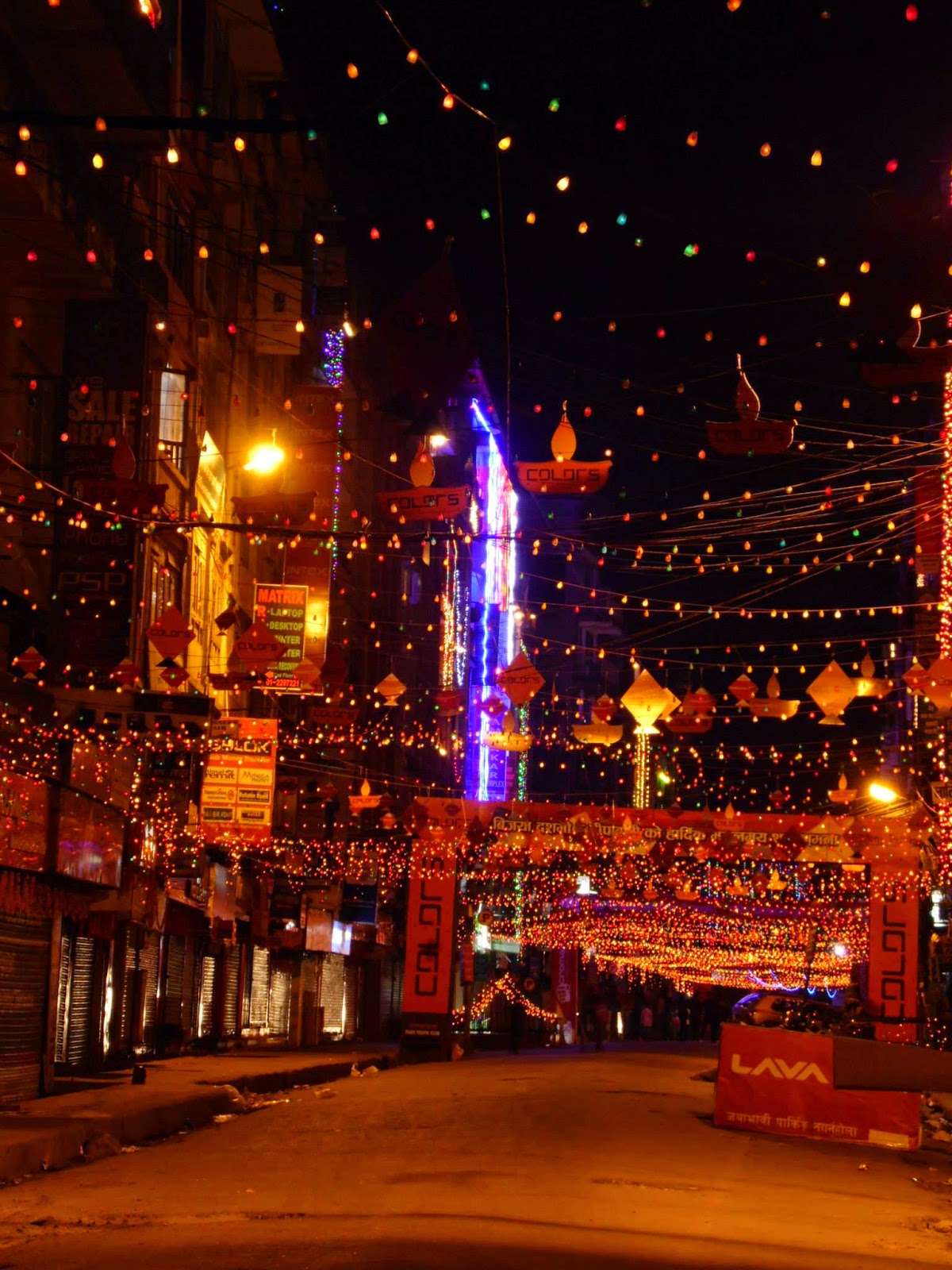
What I love most about this festival is that it is also called the festival of light. For three days straight, Kathmandu's citizens enjoyed full-time electricity with no load-shedding. The city was lit up in colorful lights. I kept saying (while vigorously taking photos): "This is such a luxury for Kathmandu ... well, but it's only once a year!"
Kathmandu city sparkling in lights (taken from Swayambhu Stupa)

In an alley, branching from one of the main roads in Kathmandu

A temple in Kathmandu Durbar Square, decorated with lights 

Kathmandu Durbar Square

Kathmandu Durbar Square

Another alley branching from a main road in downtown Kathmandu

Aside from roaming the city in the evening to take photos, I do not have any personal take on Tihar like I did during Dashain. I did come to my friend's house on the forth day and we made Selroti together, a sort of round donuts - traditional food during Tihar. It was lots of fun actually because no matter how much we tried, we could not get it in round and plumed shape like they did in the stores. Tihar is also the time for those with sweet tooth. Gosh, they eat so much sweets here for the past few days!

During Tihar, most shops were closed but sweets shops were always open! 

The streets and the markets during the week of the festival were filled with flowers garlands and colorful powder (for seven-color tika) being sold on pavements.
Color powder is mixed with water to make tika
Flowers garlands

I feel blessed and glad to be here during this festivals season. Kathmandu has been so lively, pretty and bustling with its busy citizens. Even modernity has had very visible impacts on people's lives here, I still hope these wonderful traditions will still live on to enrich the spiritual lives of many more Nepali generations to come. It makes me giggle every time I touch upon the matter of modernity and tradition, Escobar always comes to my mind. It could be that I have had to read his book Encoutering Development ... for so many times due to assignments at school. Almost 20 years ago, he was already worried about the local culture and traditions being destroyed by modernity because development was strongly accompanied with modernity and economic growth regardless of anything else. Development, as a result, was being conducted carelessly at the time in regard of culture preservation. Now, 20 years later, his prediction has become more visible than ever in developing countries such as Nepal.

When I was at Yamaleswar Mahadev to seize the opportunity of entering the temple which only happens once a year, right next to the traditional rituals being conducted, people with all sorts of digital devices: camera, smart phones, notepads ... vigorously taking photos and taping videos. Well, I am glad people's lives have gotten better in term of meterials. However, in situations like this, living in the moments should be more important than looking at them through the cameras lens. As a tourist, I do take tons of photos, I'm tired of it sometimes but I know I'm going to regret it afterward if I don't have some photos to mark places I've been or things I've seen. Well ... I could also be quite unreasonable sometimes.